






How Much Does It Cost to Maintain a Yacht Per Year?
- 1. What Does Annual Yacht Maintenance Cost Cover?
- 2. Hidden Yacht Maintenance Costs
- 3. Annual Yacht Maintenance Cost by Yacht Size
- 4. First-Year Maintenance Budget for a Used Yacht
- 5. How Much Does Yacht Maintenance Cost in Dubai?
- 5.1 Impact of High Temperature on Systems (Cooling & Batteries)
- 5.2 Saltwater Corrosion & Marine Environment
- 5.3 Hull Cleaning & Maintenance Frequency
- 5.4 Seasonal Cost Differences (High Season vs Hot Season)
- 5.5 Storage, Winterization & Year-Round Usage
- 5.6 Typical Dubai Operator Maintenance Checklist
- 5.7 Dubai vs Global Maintenance Cost Pattern
- 6. Annual Yacht Ownership Cost Breakdown
- 7. Annual Maintenance Cost Examples for Different Yachts
- 8. Is It Cheaper to Own or Charter a Yacht?
- 9. Can You Afford the Annual Cost of Yacht Ownership?
- 10. How to Reduce Your Annual Yacht Maintenance Cost
- 11. FAQ
Quick Answers
Annual yacht maintenance and total ownership costs are not the same.
A common planning rule is to reserve around 10% of the yacht's value for routine maintenance and repairs. However, total annual ownership costs may be substantially higher once dockage, insurance, fuel, crew, yacht management and unexpected repairs are included.
Owner-operated yachts under 50 feet may cost tens of thousands of dollars per year, while professionally crewed yachts above 70–100 feet can require annual budgets ranging from several hundred thousand dollars to more than $1 million.
The actual figure depends on the yacht's size, age, type, usage, crew requirements and home port.
As a yacht owner with 10 years of sailing experience, I am to provide a comprehensive guide on how much does a yacht cost to maintain annually. This includes both routine maintenance and hidden expenses, empowering you to make a more informed assessment of cash flow and budget planning before buying a yacht.
What Does Annual Yacht Maintenance Cost Cover?
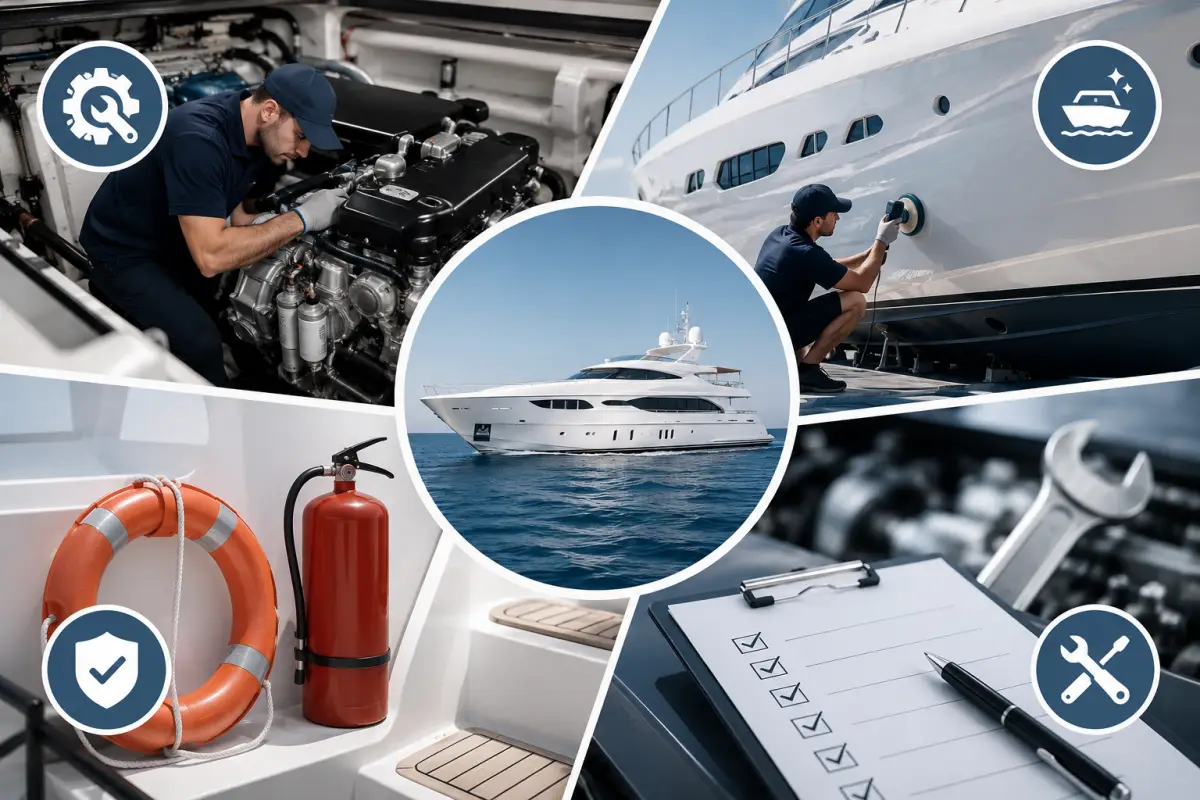
Many people assume that yacht maintenance costs are limited to engine maintenance or hull cleaning. In reality, annual yacht maintenance costs refer specifically to the ongoing technical upkeep required to keep a yacht in safe and seaworthy condition. They generally encompass four major categories of expenditure:
Basic Mechanical and Hull Maintenance
This represents the most direct yacht maintenance cost, typically including:
• Engine, generator, and other mechanical system upkeep
• Hull cleaning, anti-corrosion, and anti-fouling treatments
• Routine inspections of electrical systems and navigation equipment
• Annual safety inspections and statutory surveys
While this portion represents a smaller percentage of total costs, it is critical for ensuring the yacht's safety and operational integrity.
Hull & Exterior Maintenance
This category focuses on the physical condition of the yacht’s structure and underwater performance.
It typically includes:
• Hull cleaning and polishing
• Anti-fouling treatments to prevent marine growth
• Anti-corrosion protection and repainting
• Deck maintenance and surface repairs
• Inspection for structural wear or damage
Proper hull maintenance directly impacts fuel efficiency, speed performance, and long-term vessel durability.
Scheduled Safety & Compliance Maintenance
Beyond physical repairs, yachts must undergo regular inspections and certification-related maintenance to remain legally seaworthy.
This includes:
• Annual safety inspections
• Fire safety and life-saving equipment checks
• Electrical safety certification
• Regulatory surveys (depending on flag state)
• Mandatory equipment replacement or servicing
These costs are not optional and are required for legal operation in most jurisdictions.
Repair Allowance & Unexpected Maintenance Costs
Even with proper upkeep, yachts may require unplanned maintenance due to wear, weather conditions, or system failure, such as:
• Emergency mechanical or electrical repairs
• Replacement of damaged onboard components
• Minor collision or docking damage repairs
• Sudden equipment malfunction (navigation, propulsion, etc.)
Major repair events can range from $5,000 to $200,000+ depending on vessel size and severity, especially for larger yachts or complex systems.
Hidden Yacht Maintenance Costs
I've noticed many buyers only budget for visible expenses such as routine servicing and fuel, while overlooking the hidden costs that often arise throughout yacht ownership. Although these expenses are less predictable, they can significantly increase the true annual cost of maintaining a yacht.
Emergency Mechanical Failures
Common sudden breakdowns include:
• Main engine failure
• Generator damage
• Hydraulic system failure
• Propeller shaft and propeller issues
Single-incident Cost Range: $5,000 – $300,000+
✅ These expenses are often not fully covered by insurance, making them a major pitfall in annual yacht operating costs that can directly blow budgets.
Corrosion & Saltwater Aging
Saltwater exposure accelerates wear on many onboard systems, even when the yacht appears well maintained.
Common corrosion-prone components include:
• Metal piping
• Propellers and thrusters
• Hull sensors
• Electrical connectors
• Air conditioning and cooling systems
Annual Hidden Corrosion Repair Costs: $2,000 – $150,000+
✅ Saltwater corrosion develops gradually and is largely unrelated to the yacht's visible appearance or age.
Temporary Marina & Port Charges
Unexpected itinerary changes can generate additional marina expenses, including:
• Temporary berthing during peak season
• Mandatory port calls for storm shelter
• Port scheduling delays
• Unplanned berthing without prior reservation
Per-occurrence Fee: $300 – $10,000+
✅ In high-demand cruising regions such as the Mediterranean and Caribbean, temporary berthing during peak season can substantially increase annual operating costs.
Customs, Immigration & Cross-Border Fees
Owners cruising internationally may also incur regulatory expenses, including:
• Entry permits
• Customs clearance fees
• Temporary import duties
• Customs brokerage service fees
Typical Annual Cost:
• Intra-regional Voyages: $2,000 – $10,000
• International Multi-Country Routes: $15,000 – $60,000+
✅ When involving the EU, additional mandatory charges may include VAT withholding, charter taxes, and port service fees.
Technology Upgrades & Equipment Obsolescence
Marine electronics often require replacement before they fail completely due to regulatory changes, manufacturer support, or insurance requirements.
Common upgrade items include:
• Navigation and radar systems
• Communication and satellite networks
• Security and surveillance systems
• Automation control systems
• Environmental emission equipment
Typical Upgrade Cost:
• Single System Upgrade: $10,000 – $50,000+
• Complete Electronic System Overhaul: $80,000 – $300,000+
✅ Many owners underestimate these lifecycle replacement costs because they are driven by technology and compliance rather than equipment failure.
Commercial Charter Operating Costs (Not Applicable to Every Owner)
Some expenses are frequently mentioned in yacht operating budgets but apply primarily to commercial charter operations, rather than private recreational ownership.
These may include:
• Crew gratuities paid by charter guests
• Temporary replacement crew
• Additional hospitality staff
• Charter compliance and guest-service costs
The table below illustrates how these costs differ depending on the yacht's operating model.
Ownership Model | Crew Tips | Temporary Crew | Included in Annual Maintenance? |
Private Owner | Usually No | Occasionally | Generally No |
Bareboat Charter | No | No | No |
Crewed Charter Yacht | Usually Paid by Charter Guests | Sometimes | Partially |
Commercial Charter Operator | Yes | Yes | Part of operating expenses |
✅ When estimating annual yacht maintenance costs, private owners should focus primarily on maintenance, repairs, insurance, marina fees, and regulatory compliance. Crew gratuities and guest-service expenses are generally considered commercial charter operating costs, not standard yacht maintenance expenses.
For most private owners, the largest hidden costs come from unexpected repairs, corrosion, regulatory fees, temporary marina charges, and technology upgrades. Understanding which expenses apply to private ownership versus commercial charter operations helps create a more accurate annual yacht maintenance budget and avoids overstating the true cost of recreational yacht ownership.
Annual Yacht Maintenance Cost by Yacht Size
As a boat owner with 10 years of sailing experience, I've found that annual yacht maintenance costs don't increase linearly. Instead, they rise in steps as the yacht's size, system complexity, and usage patterns increase.
While many people interpret "maintenance" as basic mechanical servicing, in real-world yacht ownership, annual maintenance costs typically includecore upkeep expenses required to keep the vessel in safe, functional, and seaworthy condition.
Maintenance Cost Breakdown by Yacht Size (Owner-Operated vs Crewed)
To provide a clearer and more practical reference, the breakdown below shows annual yacht maintenance costs by size, while also distinguishing between owner-operated and professionally crewed usage patterns, since these two scenarios significantly affect maintenance intensity and related servicing requirements.
Yacht Size | Scenario | Maintenance Only (Annual) | Total Operating Budget (Annual) | Typical Crew | Estimated Usage | Key Cost Drivers |
30ft | Owner-Operated | $5K – $15K | $10K – $25K | None | 20–50 days/year | Basic servicing, docking, insurance |
30ft | Crewed | Not typical | Not typical | — | — | — |
40ft | Owner-Operated | $8K – $20K | $15K – $35K | None / occasional captain | 30–60 days/year | Marina fees, fuel, hull cleaning |
40ft | Crewed | $20K – $40K | $40K – $80K | 1 captain (part-time) | 30–70 days/year | Captain fees, insurance requirements |
50ft | Owner-Operated | $15K – $35K | $30K – $70K | None / freelance captain | 40–80 days/year | Engine servicing, berth, insurance |
50ft | Crewed | $40K – $90K | $80K – $180K | Captain + deckhand | 50–100 days/year | Crew salaries, provisioning, marina capacity |
65ft | Owner-Operated | $30K – $70K | $70K – $150K | Usually at least 1 captain required | 60–120 days/year | Insurance, systems complexity, docking |
65ft | Crewed | $80K – $180K | $150K – $350K | Captain + 1–2 crew | 80–150 days/year | Crew payroll, charter readiness standards |
80ft | Owner-Operated | $50K – $120K | $120K – $250K | At least 1 captain | 80–160 days/year | Compliance, marina costs, insurance limits |
80ft | Crewed | $120K – $300K | $250K – $600K | Captain + 2–3 crew | 100–180 days/year | Staffing, guest services, maintenance intensity |
100ft | Owner-Operated | $100K – $250K | $250K – $500K | Mandatory professional captain | 100–200 days/year | Insurance, refit cycles, technical systems |
100ft | Crewed | $250K – $600K | $500K – $1.2M | 4–8 crew | 120–240 days/year | Crew salaries, hospitality-level operations |
130ft+ | Crewed only | $500K – $2M+ | $1M – $5M+ | 6–20+ crew | 150–300+ days/year | Full luxury operation, refits, classification surveys |
Annual Yacht Maintenance and Operating Cost Chart
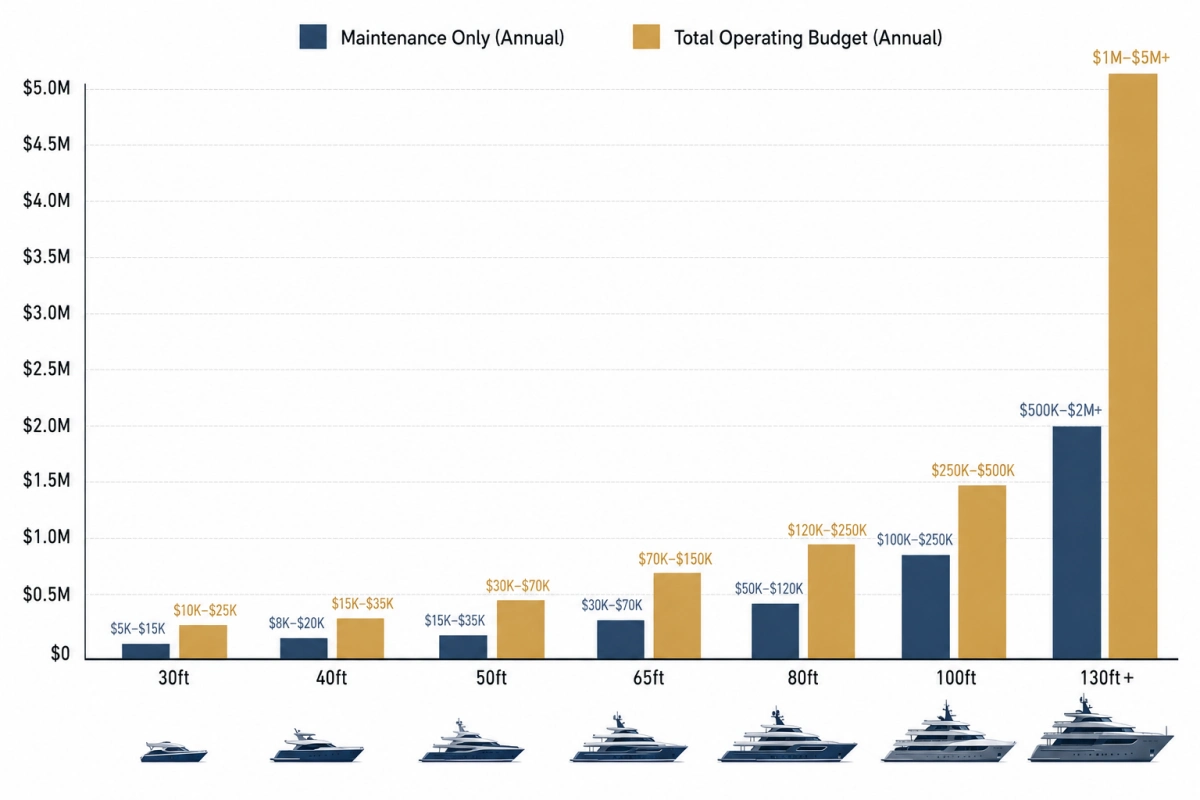
Maintenance Cost Still Scales with Operational Intensity
Annual yacht maintenance costs depend not only on size but, in practice, also largely on how the yacht is used:
• Owner-operated yachts typically have lower usage intensity but more variable upkeep cycles
• Professionally crewed yachts maintain higher operational readiness, leading to more consistent maintenance schedules
• Larger yachts require exponentially more structured maintenance due to complex onboard systems
I wish to emphasize one point: the annual maintenance cost of a yacht does not simply follow the principle of "the bigger, the pricier." It is influenced by multiple factors—including size, the complexity of mechanical and electronic systems, crew configuration, and the waters navigated—resulting in a stepwise increase. Understanding this is crucial for accurately budgeting annual yacht operating costs and assessing one's annual maintenance requirements and long-term upkeep expectations.
First-Year Maintenance Budget for a Used Yacht
When purchasing a used yacht, the first-year maintenance cost is often significantly higher than in subsequent years. This is because the vessel typically requires catch-up maintenance, system servicing, and repairs identified during the marine survey process.
Unlike ongoing annual yacht maintenance costs, the first year is influenced heavily by the yacht's previous usage history, maintenance quality, and how long certain systems have been deferred.
A professional marine survey commonly reveals issues that are not immediately visible during purchase, leading to unexpected first-year expenditures.
Typical First-Year Maintenance Components
The most common first-year maintenance and refit expenses include:
• Marine Survey Findings Repairs: Structural, mechanical, or safety-related issues identified during inspection
• Deferred Maintenance Catch-Up: Previously delayed servicing now required at once
• Engine and Generator Service or Overhaul: Full inspection, fluid replacement, and potential component replacement
• Battery Replacement: Aging marine batteries often require full replacement after purchase
• Electronics and Navigation Systems Updates: Radar, GPS, autopilot, and communication systems calibration or upgrades
• Safety Equipment Renewal: Life rafts, fire extinguishers, EPIRB, and emergency systems compliance checks
• Antifouling and Hull Treatment: Full repainting and hull protection for performance and corrosion prevention
• Hoses, Pumps, and Plumbing Systems Replacement: Common wear-and-tear items in older vessels
• Air-Conditioning Servicing or Replacement: Especially in warm climates with high system load
• Cosmetic Refurbishment: Interior cleaning, upholstery repair, teak restoration, and detailing
Why the "10% Rule" Is Not Always Accurate
Based on YachtWorld's research into the actual cost of yacht ownership, it is recommended to set aside 10% of the yacht's value to cover annual maintenance expenses.
In reality, the first year is often a correction phase, where deferred maintenance and survey-identified issues are resolved before the yacht enters a stable annual operating cycle.
Therefore, first-year costs should be treated separately from long-term annual maintenance expectations when budgeting for yacht ownership.
How Much Does Yacht Maintenance Cost in Dubai?
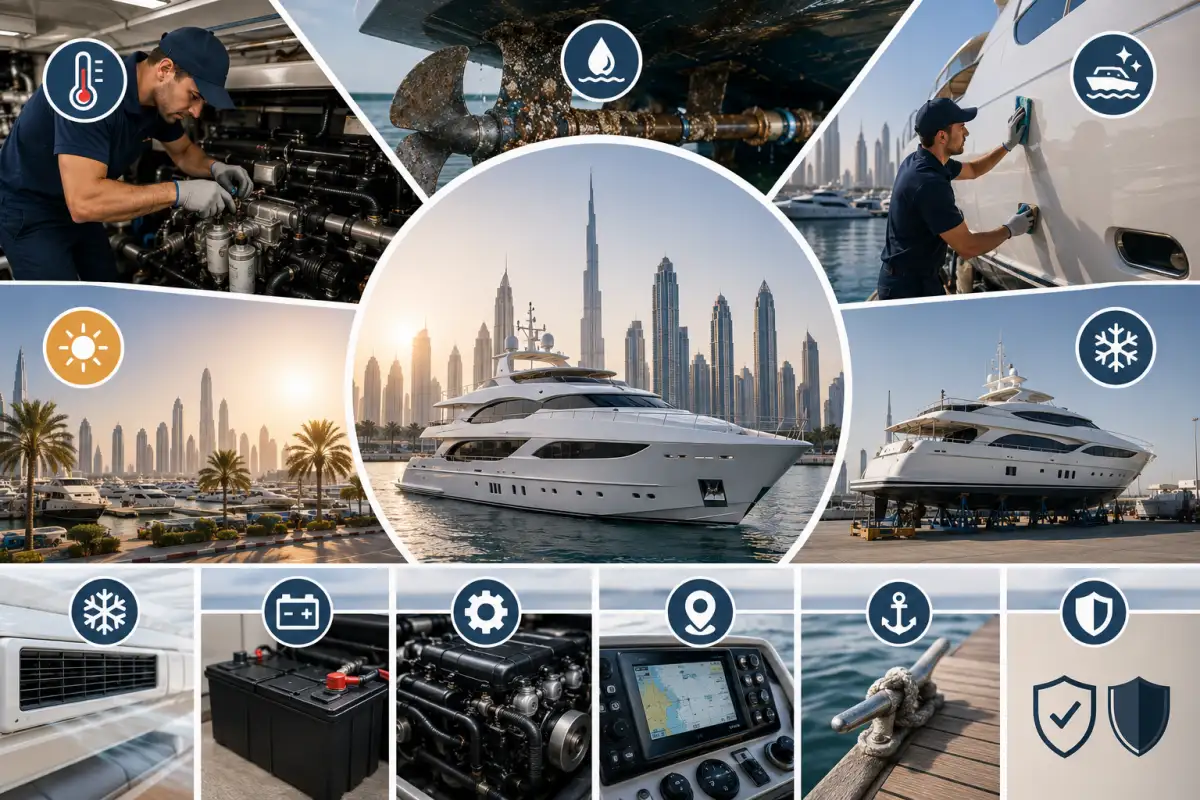
Yacht maintenance costs in Dubai follow a similar structure to global markets but are significantly influenced by climate conditions and seasonal demand. Compared with Europe or the U.S., the combination of extreme heat, high salinity, and year-round usage creates a distinct cost profile.
Impact of High Temperature on Systems (Cooling & Batteries)
Dubai's extreme heat plays a major role in yacht maintenance costs.
• Continuous load on air-conditioning systems during most of the year
• Accelerated wear on marine batteries due to high ambient temperature
• Increased demand on engine cooling systems and generators
• Faster degradation of electronic components in enclosed compartments
As a result, yachts in Dubai often require:
• More frequent AC servicing (sometimes every 3–6 months)
• Earlier battery replacement cycles compared to temperate regions
• Enhanced ventilation and cooling system upgrades
Saltwater Corrosion & Marine Environment
The Arabian Gulf has high salinity levels, which directly increases corrosion rates.
Common affected components include:
• Metal fittings and railings
• Propellers and thrusters
• Electrical connectors and sensor systems
Because of this, yacht operators in Dubai typically follow a more intensive anti-corrosion routine, including:
• More frequent hull inspections
• Regular freshwater washing after each trip
• Shorter antifouling cycles compared to cooler regions
Hull Cleaning & Maintenance Frequency
Due to warm water and high salinity, hull fouling occurs faster in Dubai waters.
Typical maintenance pattern:
• Light Cleaning: Every 2–4 weeks
• Full Hull Wash: Monthly or bi-monthly
• Antifouling Treatment: Every 6–12 months depending on usage
Seasonal Cost Differences (High Season vs Hot Season)
Dubai yacht maintenance costs are also influenced by seasonal usage patterns:
High Season (November – March)
• Peak yacht usage
• Higher charter utilization pressure
• More frequent cleaning cycles due to higher activity
Hot Season (April – October)
• Reduced cruising frequency
• Reduced charter activity but higher cooling costs
• Increased preventive maintenance instead of usage-based wear
Storage, Winterization & Year-Round Usage
Unlike colder regions, Dubai does not require traditional winter storage.
However:
• "Summer downtime" is often used for deep maintenance
• Some owners temporarily relocate yachts to cooler waters (Mediterranean seasonality migration)
• Continuous berthing is common due to year-round sailing conditions
This reduces storage costs but increases continuous wear-and-tear expenses.
Typical Dubai Operator Maintenance Checklist
Based on standard marina and fleet maintenance operations in Dubai, a typical annual checklist includes:
• Monthly hull wash and salt removal
• Quarterly engine and generator inspection
• AC system servicing every 3–6 months
• Battery load testing and replacement planning
• Navigation system calibration checks
• Anti-corrosion treatment cycles
• Mooring and dock line inspections
Dubai vs Global Maintenance Cost Pattern
In summary, yacht maintenance in Dubai is not defined by higher base costs, but by:
• Higher system load due to climate
• More frequent preventive maintenance cycles
• Faster corrosion and cooling system wear
For most yacht sizes, Dubai tends to shift maintenance spending from "repair-based cost" to preventive, frequency-based maintenance cost.
Annual Yacht Ownership Cost Breakdown
I'm often asked, “How much does it actually cost to own a yacht each year?” In reality, the yacht ownership cost breakdown isn't a fixed expense but consists of multiple highly variable costs. Different regions, yacht types, and usage frequency can cause annual expenses to vary significantly.
To clearly illustrate each expense, yacht running costs per year are classified according to generally accepted standards into the following six main categories:
Dockage & Marina Fees
• USA: 30–50 ft $6,000–$18,000 / year, 70+ ft $30,000–$80,000+ / year
• Mediterranean/Caribbean: May double during peak season
• Winter Discounts: Winter storage or off-peak contracts may reduce costs by 20%–50%
Fuel Costs
Fuel consumption is highly dependent on yacht type, engine size, and usage patterns.
• Powerboats: $10,000 – $300,000+ / year
• Sailboats: $5,000 – $15,000 / year
• Fuel expenses vary significantly based on usage hours, differing by up to 5x
Insurance
The sum insured is influenced by the vessel's value, its operating area, and the shipowner's experience.
•Premium Rates: 0.5%–2%/year, influenced by vessel value, age, operating waters, and operator experience
•Private Yachts Typically: $5,000–$150,000/year
Routine Maintenance & Repairs
•Small Vessels: $3,000–$10,000
• Medium: $10,000–$40,000
• Large: $50,000–$200,000+
• Emergency repairs may exceed hundreds of thousands of dollars
Crew Salaries & Expenses
• Captain: $60,000 – $180,000
•Deckhand: $35,000 – $70,000
•Engineer: $70,000 – $150,000
•Additional expenses for lodging, insurance, training, and travel
•Crew costs account for 30%–45% of total operating expenses
Winter Storage, Haul-Out & Taxes
This category includes seasonal storage, maintenance positioning, and compliance-related expenses.
• Small Yachts: $2,000–$6,000
• Medium Yachts: $6,000–$20,000
• Large Yachts: $30,000–$100,000+
Annual Cost Summary by Yacht Size
Cost Category | 30–40 ft Yacht | 50–60 ft Yacht | 70–90 ft Yacht | 100+ ft Superyacht |
Annual Ownership Cost | $20k–$60k | $80k–$250k | $300k–$900k | $1M–$5M+ |
Dockage | $6k–$15k | $20k–$50k | $30k–$80k | $50k–$200k+ |
Fuel | $5k–$15k | $20k–$60k | $50k–$200k | $100k–$500k+ |
Crew | None / Minimal | $20k–$40k | $100k–$250k | $300k–$1M+ |
Insurance | $2k–$8k | $8k–$18k | $20k–$60k | $50k–$150k+ |
Maintenance | $3k–$10k | $10k–$40k | $50k–$200k | $100k–$500k+ |
Storage & Taxes | $2k–$10k | $5k–$25k | $30k–$150k | $100k–$500k+ |
Annual yacht ownership costs include dockage fees, fuel consumption, insurance, maintenance, crew, and storage-related expenses. These costs vary significantly depending on yacht size and usage intensity.
Understanding this breakdown helps owners and potential buyers accurately estimate real annual financial commitments and plan yacht ownership more effectively across different operating conditions.
Annual Maintenance Cost Examples for Different Yachts
Based on my extensive experience monitoring the North American and Caribbean markets, the real cost of owning a yacht per year varies significantly across different yacht sizes. I've compiled four typical case studies to help you better understand the actual annual expenses of yacht ownership:
Yacht Type | Annual Maintenance Cost | Maintenance Focus | Typical Use |
35ft Sailboat | $8K–$18K | Hull cleaning + rigging + basic systems | Coastal sailing |
55ft Motor Yacht | $25K–$60K | Engine servicing + hull maintenance | Family cruising |
85ft Luxury Yacht | $80K–$180K | Mechanical systems + electronics + structural upkeep | Private cruising |
140ft Superyacht | $200K–$600K+ | Full technical systems + refit preparation | High-end private use |
From 35 feet to 140 feet, annual yacht operating costs increase in significant increments. For smaller self-piloted vessels, mooring fees and basic maintenance account for the largest share; whereas for large commercial and superyachts, crew salaries, fuel, port fees, and management systems become the primary cost drivers.
Understanding these real-world examples helps you more accurately assess cash flow and annual budgets before purchasing a yacht, preventing underestimation of operating costs.
Is It Cheaper to Own or Charter a Yacht?
Many people ask: Is it more cost-effective to buy a yacht outright, or is it better to just rent one when needed?
Yachts are almost never a money-saving asset. Only when usage frequency is sufficiently high, and with a stable home port and cash flow, can owning a yacht become a rational choice by spreading costs over the long term.
Ownership vs. Charter Annual Cost Comparison (Based on a 55ft Mid-Size Motor Yacht)
Aspect | Own Yacht | Charter Yacht |
Purchase Cost | $1.2M (one-time) | $0 |
Annual Maintenance & Ops | $140K–$190K | Included in rental |
Fixed Annual Cash Flow | ✅ Required | ❌ None |
Daily Usage Cost | Lower with more use | Higher with more use |
Flexibility | Low (port & seasonal limits) | High (global options) |
Hidden Risks | Maintenance, depreciation | Covered by charter company |
When Yacht Charter Is More Practical
Yacht charter is generally more suitable when:
• Annual sailing < 6–8 weeks
• No fixed berthing requirements
• Prioritize "experiencing different vessel types or waters"
• Unwilling to bear the uncertainty of unexpected yacht maintenance costs
• Prefer not to have capital locked in illiquid assets long-term
In these cases, chartering provides a more efficient and flexible way to enjoy yachting without exposure to ongoing maintenance obligations.
When Yacht Ownership Becomes Reasonable
Owning a yacht becomes more justifiable when:
• Actual annual usage ≥ 8–10 weeks
• Secure long-term berthing (private marina preferred)
• Part of maintenance costs can be offset through charter income
• Sufficient cash flow independent of yacht asset returns
• Viewing the yacht as a "lifestyle platform" rather than an investment vehicle
Even in these scenarios, maintenance remains a core ongoing cost factor that must be carefully budgeted.
While yacht ownership offers long-term access and personalization, it also introduces continuous maintenance responsibilities that cannot be avoided. Yacht charter, on the other hand, removes these obligations entirely and allows users to pay only for actual usage.
Can You Afford the Annual Cost of Yacht Ownership?
Before buying a yacht, it's worth asking a more practical question than "How much does a yacht cost to maintain annually?": Can you comfortably afford the ongoing cost of ownership?
Beyond the purchase price, yacht ownership involves recurring maintenance, operating expenses, and occasional unexpected repairs. A simple budget checklist can help determine whether owning a yacht is financially sustainable for your lifestyle.
Yacht Ownership Budget Checklist
Use the following checklist before making a purchase:
Question | Why It Matters |
Can you comfortably cover annual fixed costs? | Annual expenses such as maintenance, insurance, marina fees, and routine servicing continue even when the yacht is rarely used. |
Have you set aside an emergency repair fund? | Unexpected engine failures, electronics repairs, or storm damage can result in significant unplanned expenses. |
Do you already have a long-term marina berth? | Berthing availability and annual dockage fees vary greatly by location and can become one of the largest recurring costs. |
Will you need a professional captain or crew? | Larger yachts often require experienced crew, adding substantial annual operating expenses. |
How many days will you realistically use the yacht each year? | Higher usage generally provides better value from ownership, while occasional users may benefit more from chartering. |
Are you comfortable with depreciation? | Most yachts depreciate over time, making ownership a lifestyle decision rather than a financial investment. |
Have you compared ownership with yacht charter? | If you only plan to cruise a few weeks each year, chartering may provide greater flexibility without long-term maintenance responsibilities. |
If you answer "No" to several of the questions above, it may be worth delaying a purchase or considering a yacht charter instead. On the other hand, if you have a realistic maintenance budget, a long-term berthing plan, and expect to use the yacht frequently, ownership may be a suitable long-term choice.
The goal is not simply to afford the purchase price, but to comfortably manage the annual maintenance costs, operating expenses, and unexpected repairs that come with yacht ownership. Planning ahead helps reduce financial surprises and ensures a more enjoyable ownership experience.
How to Reduce Your Annual Yacht Maintenance Cost
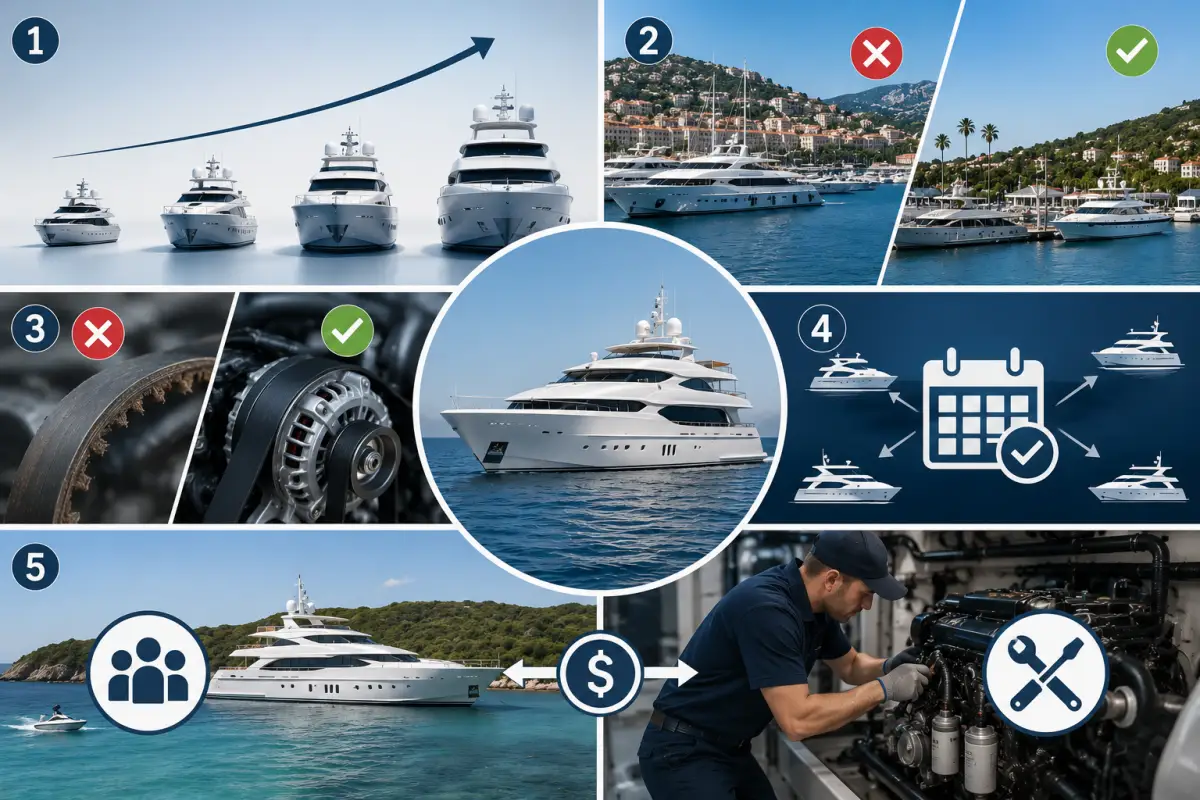
I'm often asked: Is there a way to reduce annual yacht maintenance costs? Based on my decade of practical experience, the five most effective strategies are as follows:
Choose the Right Size
Yacht size has a direct impact on long-term maintenance complexity and system workload. As vessel size increases, maintenance requirements rise significantly:
• 40 ft → 55 ft: Maintenance systems become more complex, costs typically double
• 55 ft → 75 ft: Additional mechanical and electrical systems increase servicing requirements
• 90 ft+: Maintenance shifts into multi-system, professional-grade servicing levels
✅ Core principle: Larger yachts require exponentially higher maintenance effort due to system complexity, not just size.
Smaller yachts (35–50ft) generally offer the most efficient balance between maintenance frequency and system simplicity.
Plan Your Mooring Location Strategically
Where a yacht is kept has a direct impact on maintenance exposure and service frequency.
High-cost marine environments often increase maintenance demand due to harsher conditions and higher service pricing:
• Mediterranean hotspots (Monaco, Saint-Tropez)
• High-traffic US coastal marinas
• Caribbean peak-season zones
Lower-cost and more stable waters generally reduce hull wear and servicing frequency:
• Secondary US coastal ports
• Select sheltered ports in Mexico
• Parts of Southeast Asia and Turkey
For the same 55-foot yacht, environmental and marina conditions can significantly influence annual maintenance intensity and cost variation.
Regular Maintenance vs. Delayed Repairs
Putting off maintenance often turns minor fixes into major overhauls.
• $800 belt replacement → Delayed into $15,000 alternator damage
• $2,000 antifouling paint → Delayed into $30,000 hull corrosion repair
✅ The Right Logic: Regular maintenance is the “cheapest repair.”
Long-term Data Shows:
• Owners with Regular Maintenance: Lower total repair costs over 5 years and higher resale residual value
• Owners with Delayed Maintenance: Higher average annual total costs and faster depreciation
Maintenance Planning Through Shared Usage
Underutilization or overuse of a yacht both increase maintenance inefficiency. When usage is low, systems degrade from inactivity; when usage is excessive, wear increases rapidly.
Shared ownership or structured usage planning can help stabilize maintenance cycles by:
• Distributing usage more evenly across time
• Reducing idle deterioration of systems
• Allowing coordinated maintenance scheduling
This approach is most effective for yachts used intermittently throughout the year.
Charter Utilization & Maintenance Balance
When yachts are made available for charter during idle periods, maintenance planning must become more structured and frequent.
Charter usage can help offset maintenance costs but also introduces:
• Higher maintenance frequency due to increased usage
• Faster wear on mechanical and interior systems
• More strict compliance and inspection requirements
⚠ While charter use may partially offset costs, it typically increases overall maintenance intensity.
The key to reducing annual yacht maintenance cost is not eliminating expenses, but managing the factors that drive maintenance frequency and system wear.
Over a long ownership period, cumulative operating, maintenance and depreciation costs can represent a substantial share of the yacht's original purchase price. Focusing solely on hull upkeep or fuel expenses is insufficient for estimating true costs. Understanding factors like vessel size, crew requirements, mooring locations, hidden expenses, and the differences between leasing versus owning enables rational decision-making. This approach allows you to genuinely enjoy yachting life without being burdened by annual maintenance costs.
About the Author
Kate Morgan brings over a decade of sailing experience to her role as a seasoned contributor to publications including Superyacht Times and International Yachting. She is also a senior member of the International SuperYacht Society (ISS). Morgan maintains a deep focus on the global yacht market, maintenance costs, and the high-end nautical lifestyle, providing expert and practical guidance for owners and prospective buyers.
Disclaimer
This article is for informational purposes only and does not constitute investment, purchasing, or financial advice. Actual maintenance costs vary based on vessel type, size, usage frequency, mooring location, crew configuration, market fluctuations, and legal regulations. Consult a professional yacht advisor, tax specialist, or legal counsel before making any decisions.
FAQ
How much does a 50 ft yacht cost to maintain per year?
Annual yacht operating costs range from $80,000 to $250,000, including: Mooring fees: $20k–$50k, Fuel: $20k–$60k, Crew: $20k–$40k, Insurance: $8k–$18k, Maintenance: $10k–$40k.
What is the 10% rule for yacht maintenance?
Annual yacht maintenance costs typically amount to approximately 10% of the purchase price, potentially rising to 15%+ for high-usage or larger vessels.
What Determines Whether Yacht Expenses May Be Tax-Deductible?
Whether yacht expenses may be tax-deductible depends on factors such as the yacht's intended use (private or commercial), ownership structure, applicable tax jurisdiction, and whether the expenses qualify as legitimate business costs under local regulations. Because tax rules vary widely between countries and individual circumstances, there is no universal answer. Always refer to your local tax authority or consult a qualified tax advisor before claiming any yacht-related deductions.
What does a 65-foot motor yacht cost annually?
A 65-foot motor yacht typically costs between $70,000 and $180,000 per year in maintenance alone. Full operating expenses, including crew and marina fees, can reach $150,000 to $350,000 annually depending on usage intensity.
How much does a 100-foot yacht cost per year?
A 100-foot yacht usually costs $250,000 to $600,000+ per year in maintenance and operations. With full crew, premium marina berthing, and refit cycles, total annual expenses can exceed $1 million per year.
Are older yachts more expensive to maintain?
Yes. Older yachts are generally more expensive to maintain due to aging engines, outdated systems, and higher repair frequency. Maintenance costs often increase significantly after 10–15 years, especially for electronics and propulsion systems.
How much should I reserve for first-year repairs on a used yacht?
For a used yacht, first-year repair and refit costs can range from 10% to 25% of the purchase price, depending on survey results. This includes deferred maintenance, system upgrades, and unexpected repair work discovered after purchase.
How much does yacht maintenance cost in Dubai?
Yes. Older yachts are generally more expensive to maintain due to aging engines, outdated systems, and higher repair frequency. Maintenance costs often increase significantly after 10–15 years, especially for electronics and propulsion systems.